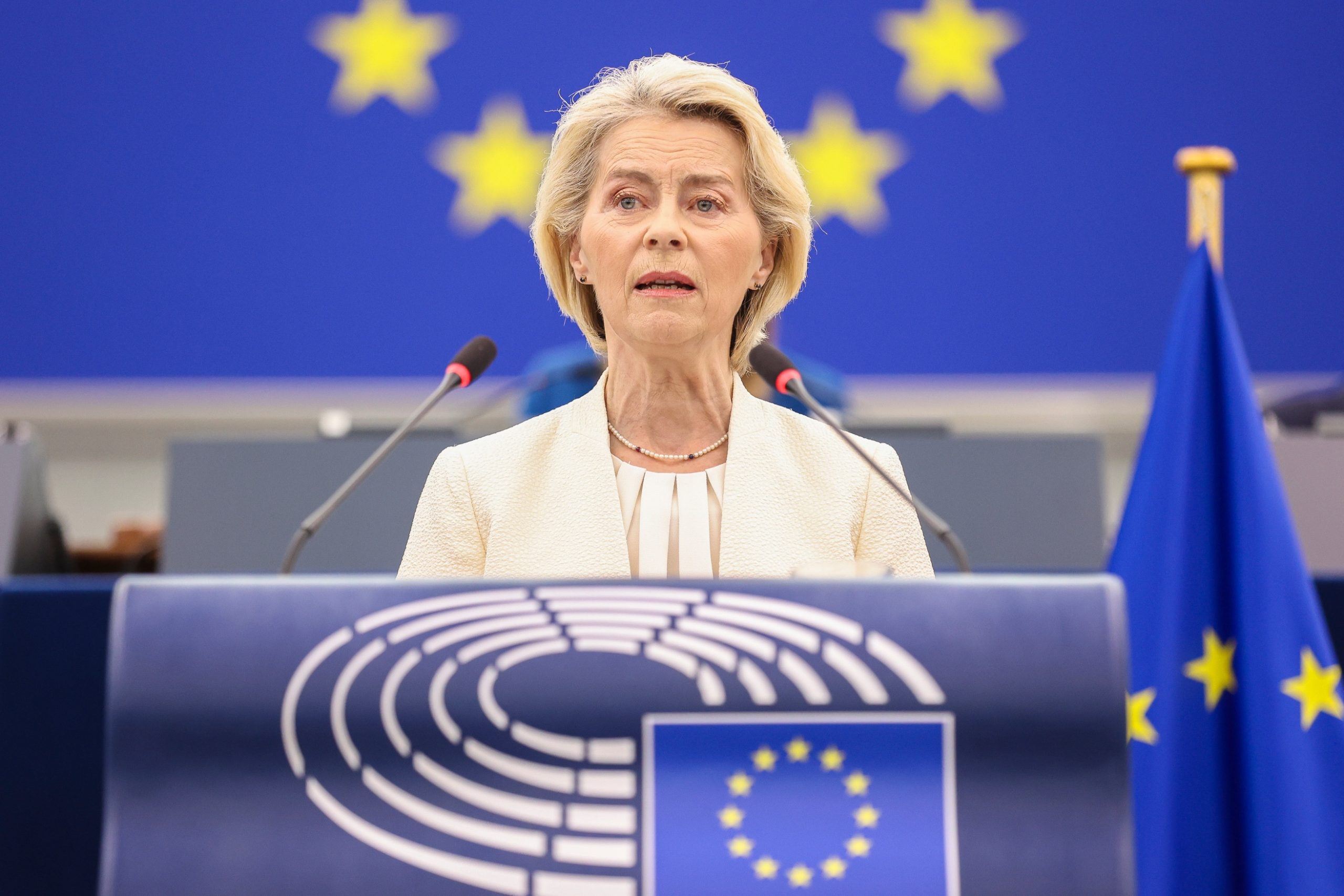
European Commission President Ursula von der Leyen focused on new forms of cooperation with non-EU countries, tighter rules for social media and greater oversight of advanced AI development in her annual State of the European Union (SOTEU) address to the European Parliament in Strasbourg.
The SOTEU is the European Commission president’s annual address to MEPs, outlining the state of the Union and the Commission’s main policy priorities. This year’s speech, her sixth across two terms, lasted around 70 minutes and covered issues including security, the economy, climate, migration and technology.
During the speech, von der Leyen proposed allowing Canada to become the EU’s first “associate member.” Such a status is not currently provided for under EU treaties and would not amount to EU membership, while its exact scope remains to be defined. The proposal would require the agreement of EU member states. Canadian Prime Minister Mark Carney has said he is seeking a closer, “unique alliance” with the EU rather than membership.
Many Europeans surveyed by Politico, including 22.3% of respondents in France, 10% in Spain and 5% in Germany, did not know who U. von der Leyen was.
On artificial intelligence, von der Leyen backed calls for a slower development of the most advanced AI models, citing risks including advanced cyberattacks. At the same time, she announced European AI initiatives in areas including healthcare, transport and defence.
On social media, she announced that the Commission would propose a ban for children under 13. Those aged 13 to 14 would only be allowed supervised “mini accounts” with limited features and usage time, while personal accounts would be allowed from age 15. Platforms would also be required to provide safer services for users aged 15 to 18.
On defence, von der Leyen proposed a European “Article 4,” a mechanism allowing a member state to convene the EU’s 27 members for a coordinated response to serious hybrid threats that do not amount to an armed attack. On climate, she announced a new European resilience framework, a heatwave plan and consideration of a joint European firefighting fleet, following a summer in which 6.6 million stremmas burned across Europe.
Sources: Reuters [1], [2], CNN, Politico [1], [2], Kathimerini


 What is fyi.news?