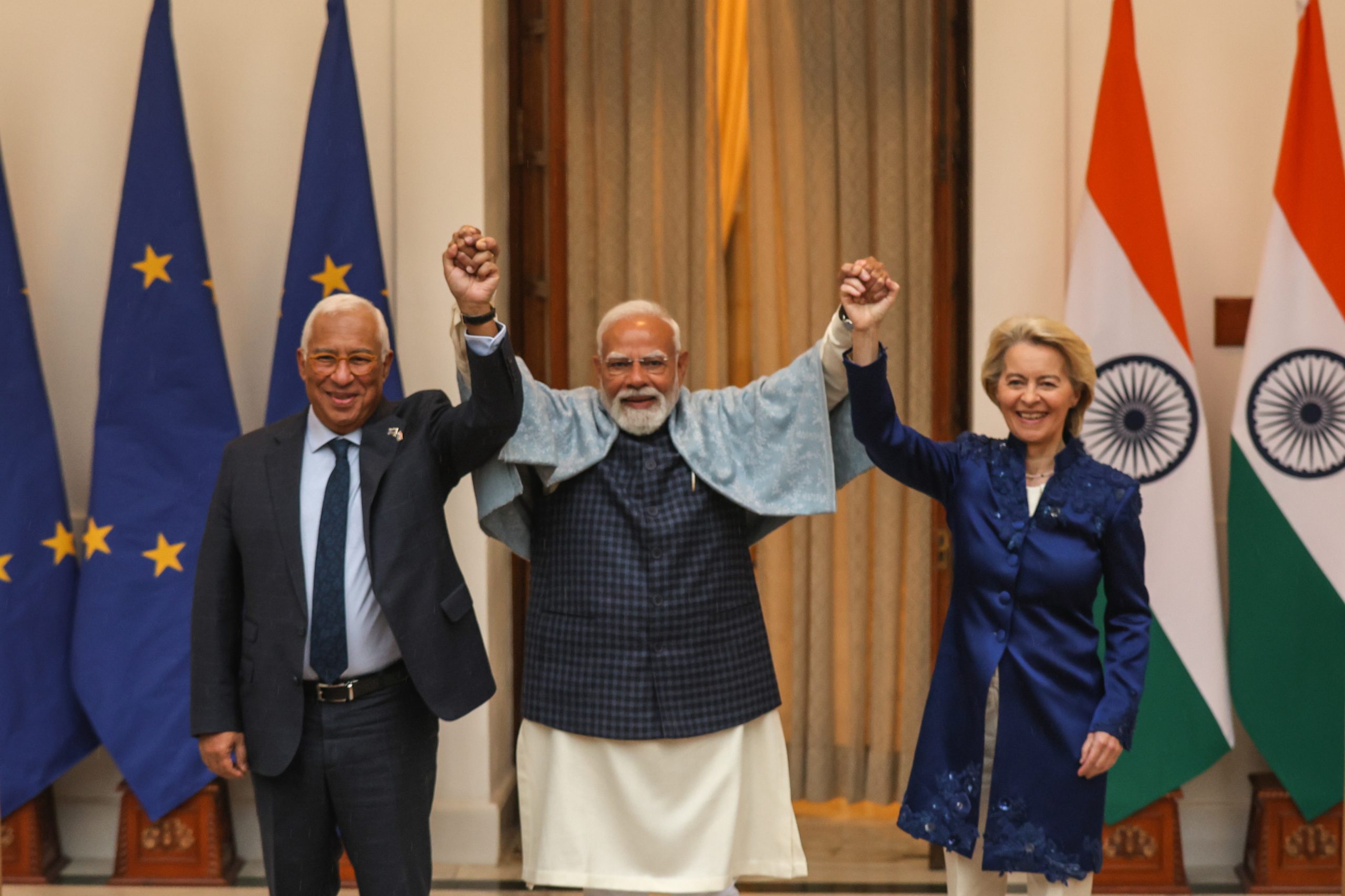
The European Union and India announced a milestone trade deal, after nearly two decades of “back and forth” in negotiations which first began in 2007 (frozen in 2013, restarted in 2022).
The President of the European Commission, Ursula von der Leyen, called the deal “the mother of all deals,” while Prime Minister Narendra Modi described it as “historic.”
The deal aims at free trade of goods between the 27 EU countries and India, which together account for approximately 25% of global GDP and a market of 2 billion people. Through it, tariffs on imports between them are expected to be significantly reduced (or even eliminated) and market access for each to the other’s market expanded.
The EU is India’s largest trading partner (in goods), with the value of their trade amounting to $136 billion (2024–25).
The tariff reduction/elimination covers many European products such as chemicals, machinery, electrical equipment, aircraft/space equipment, and also cars, whose tariffs (which reached 110%) will drop to 10% for a specific number of vehicles (up to 250,000). It is worth noting that sensitive agricultural sectors such as dairy and sugar are excluded.
Modi also mentioned that the deal will particularly benefit farmers and small businesses from India, which will gain easier access to the European market. The EU is already India’s largest trading partner (in goods), with the value of their trade amounting to $136 billion (2024–25), almost double compared to a decade ago.
The conclusion of the deal comes at a time of increased pressure from the US, which has imposed tariffs of up to 50% on India and regularly uses tariff imposition as leverage on the EU (e.g., regarding Greenland).
Sources: ΒBC, Reuters


 What is fyi.news?