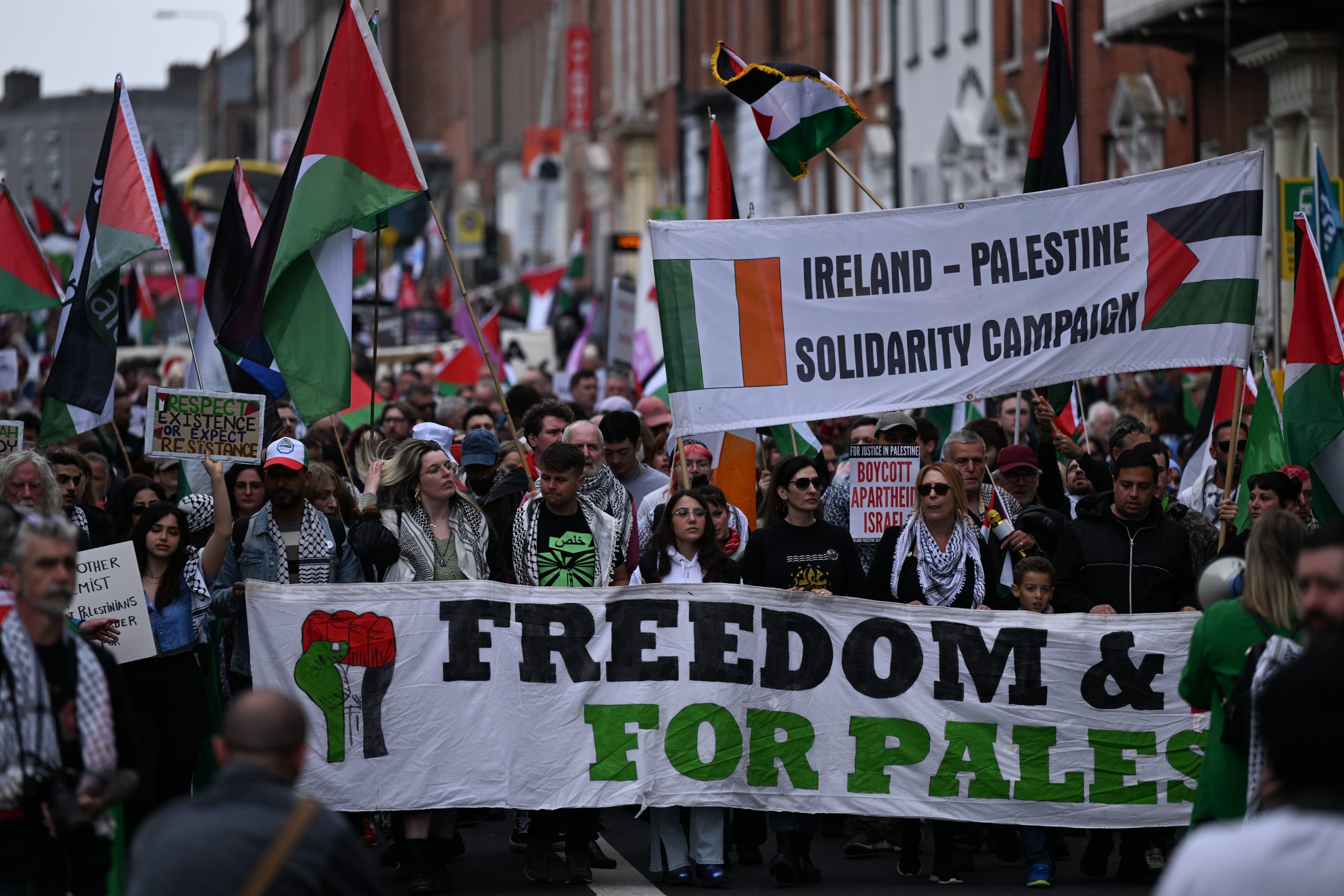
“In the end, the Irish government refused to adopt Frances Black’s proposal in its entirety and instead presented its own more limited legislation last year, which prohibits trade in goods but not services, such as technology, tourism and information technology, which are provided to the settlements by companies based in Ireland,” Conor O’Neill points out.
These services account for approximately 70% of Ireland’s trade with the rest of the world and therefore represent a significant weakening of the original legislative proposal.
According to Conor O’Neill, the Irish government backed down due to fears that such measures could affect the American multinational corporations established in the country.
The government insists that, rather than including services in the embargo itself, it will promote an EU-wide ban on trade with the settlements covering both goods and services, “although this will be difficult given the current European political landscape,” says Conor O’Neill.
“The legislation is a step forward, but it could and should be far more ambitious. We will continue our campaign until a full and comprehensive ban is implemented.”
The discussion at the European level
A few days after the bill’s approval, on Monday, 13 July, discussions at the European level did indeed begin, as several countries hoping for a common European initiative have already introduced similar proposals at the national level. Relevant legislative procedures are already underway in the parliaments of Belgium and the Netherlands, while outside the EU, Norway has announced a similar plan.
“The European Commission’s proposal is limited to trade in goods and is currently at the centre of an ongoing technical and legal dispute as to whether unanimous approval is required or whether it could be adopted by a qualified majority of Member States,” explains Conor O’Neill.
The European Commission is considering three alternatives: a partial or complete ban on imports from the settlements, the imposition of high tariffs that would make trade economically unviable, and the implementation of an import licensing system.
A document revealed by Euronews emphasises that these options “may have a substantial impact on EU–Israel relations, also taking into account the upcoming elections [in Israel].” The elections will take place on 27 October and will be the first since 7 October 2023, when Hamas carried out attacks in Israel.
What remains unclear, however, is the issue highlighted by Conor O’Neill regarding whether unanimity or a qualified majority of Member States is required. Under the current circumstances, unanimity appears impossible, as the Council is divided: on one side are the countries pressing for stricter measures, supported by the EU’s High Representative for Foreign Affairs, Kaja Kallas; on the other are European Commission President Ursula von der Leyen and countries such as Germany and the Czech Republic.
Nevertheless, as POLITICO points out, any trade measures adopted would have a limited economic impact on Israel, since trade with the illegal settlements in the West Bank accounts for approximately 0.5% of total EU–Israel trade, according to Commission estimates. The EU is, moreover, Israel’s largest trading partner.
“If the EU were to use its collective economic power and prohibit all forms of trade and investment in the illegal settlements, it would cut off a key source of their revenue. It would contribute to their economic isolation and provide incentives for companies to end their commercial involvement, which has played a very significant role in the expansion of the settlements,” says Conor O’Neill.
“Realistically,” however, “the EU and its Member States should be pursuing much broader economic sanctions against Israel.”
He concludes that:
“Unfortunately, we are still far from reaching political agreement on anything broader in the short term, which makes a ban on trade with the settlements more likely. However, we should never accept that this is sufficient.”
Until the next meeting of the EU Foreign Affairs Council in October, however, we may see additional EU Member States taking action at the national level, as Spain and Ireland have already done.
The question of whether it is “enough,” however, remains.
The Hague Court’s ruling creates international legal obligations
In reality, statistics show that halting trade with the Occupied West Bank alone is “not enough” to have an overall impact on Israel’s economy. However, it is a fact that Spain’s decision in 2025 and Ireland’s decision now are creating a domino effect. This is because discussions at ministerial level might never have begun had these two countries not adopted the International Court of Justice’s ruling.
“Despite the International Court of Justice’s opinion, Ireland still has not gone far enough and, until a complete ban on all commercial activity—covering both goods and services—is implemented, we will continue to be in breach of the international legal obligations identified by the Court,” explains Conor O’Neill.
He emphasises that the International Court of Justice’s opinion creates “international legal obligations.” Therefore, he stresses that:
“Because the settlements are a major issue, are unquestionably illegal and, under international law, all countries are obliged to cease trading with them, this measure remains very limited.”
He concludes:
“Realistically, years of statements and strongly worded condemnations have done nothing to deter the settlement movement, and meaningful economic measures will be required to change the situation. International law must be applied equally to everyone; otherwise, our commitment to it exists in name only.”


 What is fyi.news?