(fyiteam)

Trials lasting minutes, sentences lasting decades: What is happening with “smuggling” cases in Greece

Add your Headline Text Here
@fyinews team

04/06/2026

Copy link
fyi:
  1. Trials lasting just a few minutes. Sentences spanning decades. And people who arrived in Greece as passengers being treated as “smugglers.”
  2. In this report, Anastasis Koutsogiannis examines what is happening in cases of “illegal transportation of third-country nationals” in Greece: from fast-track procedures and interpretation problems to harsh convictions and the stories of people who tried to escape war and violence.
  3. Who ultimately pays the price for a system with no safe routes?

by Anastasis Koutsogiannis

For the past three years, Sudan has been transformed into a landscape of brutal and relentless violence due to the civil war, which has left hundreds of thousands dead (estimated at more than 150,000), around 9.5 million internally displaced people, and another 4.35 million displaced in neighboring countries.

Basic infrastructure has collapsed, access to drinking water, food, and medicine is extremely limited, and millions of children are suffering from acute malnutrition, leading many international organizations to describe the situation as “the worst humanitarian tragedy of the 21st century.”

“We decided with my husband to leave Sudan shortly after the war began,” S.A.*, the mother of a young child, tells fyi.news. “I saw horrific things and many people dying before my eyes. We thought it would be safer to seek refuge in Libya,” she continues.

“We stayed in Libya, under terrible conditions, for about a year. When we managed to save some money, we started looking for ways to get to Europe. Escaping by boat was our only option,” she says.

*For security reasons, we refer to her only by her initials. Her full details are available to fyi.news.

Arrival in Crete

(REUTERS/Nicolas Economou)

However, reaching Europe does not mark the end of the ordeal.

Almost 24 hours after their arrival in Crete, the Greek authorities arrested her husband and transferred her and her child to a detention center.

“Twenty days passed without me knowing where he was. One day he called and told me he was being held in Athens. Although I tried to visit him four times with our child, we were not allowed to see him because I did not have our marriage certificate with me. I had left it in Sudan,” S.A. continues.

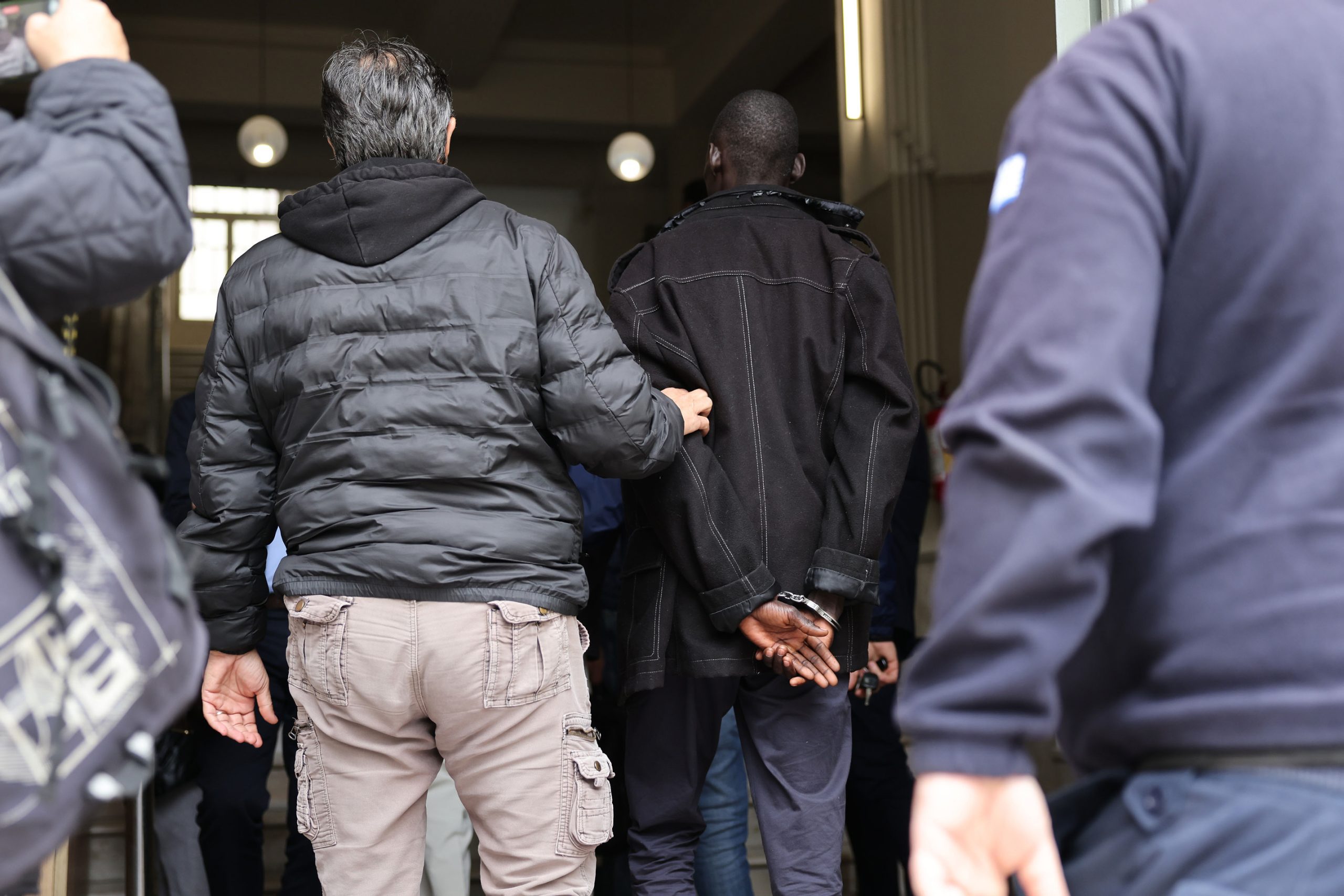
Her husband was brought to trial a few months later in Chania, charged with the “illegal transportation of third-country nationals.” With the help of the collective 50 out of many, she managed to attend the trial.

“The judge asked me a few questions, which I answered. I even showed him a video from the boat proving that my husband was not steering it but was looking after the baby. However, he did not seem interested.”

When she heard the sentence, S.A. says the ground disappeared beneath her feet:

“Ten years in prison.”

Her husband is now serving that sentence, alongside approximately 2,500 migrants who are detained or have been convicted on the same charge, making them one of the largest population groups in Greek prisons.

“Not everyone in prison is a smuggler. They do not take money from people. Whatever money we had, we paid to the Libyans before we left,” she stresses.

“I’ve been left helpless with a baby. It’s as if all three of us were imprisoned,” she concludes.


A recurring pattern

(REUTERS/Nicolas Economou)

S.A.’s story is one of dozens confirming the findings of a report by CPT–Aegean Migrant Solidarity and the Border Violence Monitoring Network: rapid-fire trials, limited time for defense preparation, inadequate interpretation services, and extremely harsh sentences for people who were themselves passengers on boats heading to Europe.

The 2025 Annual Trial Monitoring Report compiles findings from the monitoring of criminal cases involving charges of illegally transporting third-country nationals without the right to enter the country (“smuggling”) during the period January–October 2025.

Based on quantitative data and courtroom observations in 123 cases involving 190 defendants, the report raises serious concerns about compliance with national and international fair trial standards.

“What we are seeing are people whose only goal was to reach Europe for the protection of themselves and their families, as international law provides, becoming the scapegoats of a failed system,” says Spyros Galinos of the Lesvos-based Aegean Migrant Solidarity program and co-author of the report.

“Instead of providing these people with the necessary safe pathways, we force them to turn to smuggling networks, become victims of exploitation, and then criminalize them for it. Clear cases of self-transport are being relabeled as ‘illegal transportation,” he adds.


The charges

(EUROKINISSI)

As in the case of S.A.’s husband, the main charge in all 123 monitored cases was “illegal transportation of third-country nationals,” brought 178 times and accounting for 94% of all charges.

Forty-seven cases were resolved through plea bargaining, an alternative procedure in which defendants confess to the act and agree with the prosecutor on a reduced sentence.

The court then confirms the agreement, ensuring that the sentence does not exceed the agreed limits. Acceptance of guilt results in a final, non-appealable conviction.

The report notes that plea bargaining was used almost universally in Chania, particularly for younger defendants, effectively becoming the default procedural route.

“Defendants often choose plea bargaining without fully understanding all the legal consequences, including the fact that a conviction may deprive them of the right to asylum and leave them with no legal means of remaining in Greece after their release,” notes Lorraine Leete, a lawyer withLegal Centre Lesvos.

“It also means that defendants cannot raise procedural or legal objections to their prosecution—and there are many possible objections in these cases—including the fact that asylum seekers and refugees are exempt from prosecution for facilitation under Article 3 of the Migration Code,” she adds.

Observers also noted instances where court-appointed lawyers addressed their clients as though they were already guilty. According to one observer’s complaint, a court-appointed lawyer told a defendant he was facing “200 years in prison” if he did not accept a plea bargain, undermining the voluntary nature of the decision.

Fast-track trials

(ΕUROKINISSI)

According to the report, trial durations ranged from 5 to 185 minutes, with an average of around 46 minutes.

Of the 102 cases in which hearing durations were recorded, 50 (49%) lasted less than 30 minutes, 24 (23.5%) lasted between 30 and 60 minutes, and only 28 (27.5%) exceeded one hour.

Average trial duration by location was:

  • 13 minutes in Chania,
  • 16 minutes in Heraklion,
  • 29 minutes in Vathy, Samos,
  • 64 minutes in Mytilene.


The report also describes conditions of “mass adjudication.” In one court session in Samos, 30 out of the day’s 33 listed cases were heard on the same day.

“The most striking thing about the length of these trials is what is at stake. After a five-minute testimony from a Coast Guard witness, who is usually the only prosecution witness in these cases, defendants are sentenced to hundreds of years in prison for what is, by definition, a victimless crime,” says Leete.

Legal representation and interpretation

(ΓΙΑΝΝΗΣ ΑΓΓΕΛΑΚΗΣ/EUROKINISSI)

Although nearly all defendants (96%) were represented by lawyers, the report documents significant obstacles to the effective exercise of the right to defense.

In many cases, lawyers were appointed shortly before proceedings began, leaving them with little time to study the case file or prepare a defense strategy.

Similar problems were identified regarding interpretation services. According to the report’s findings, shortcomings or malfunctions were observed in 94% of cases, while case files are never translated into the defendants’ languages.

These deficiencies directly affect defendants’ ability to understand the proceedings and participate meaningfully in their defense.

“The right to interpretation is fundamental in criminal trials because it is inseparable from the right to defense. However, we have found that interpretation is either not provided at all or is inadequate,” explains Leete.

“Some people have returned to police stations after their trials without understanding what happened. Defendants—and even their lawyers—often do not raise legal objections regarding inadequate interpretation because doing so could result in further delays and longer periods of detention,” she says.

Convictions and astronomical fines

(EUROKINISSI)

The sentencing data are equally striking.

Observers recorded 36 identical ten-year prison sentences—exactly like the one imposed on S.A.’s husband—which accounted for 84% of a particular category of cases.

Meanwhile, the average cumulative sentence for the offense of “illegal transportation of third-country nationals” reached 62.5 years, while the average effective prison term amounted to 17.31 years.

In some cases, financial penalties reached hundreds of thousands of euros. Courts in Vathy, Rhodes, and Mytilene typically imposed fines ranging from approximately €200,000 to €800,000, with most clustering around €500,000.

The highest fine recorded was €840,500 in a case heard in Mytilene.

“Unfortunately, the conclusions emerging from our ongoing research point to systemic obstacles in the organization and functioning of the Greek courts, to the detriment of the genuine administration of justice,” comments Galinos.

“And in all this, those who usually suffer the consequences are members of marginalized communities who already face various forms of discrimination—in this case, people on the move,” he adds.

“In essence, we are witnessing people whose lives are being judged while they remain extras in a theatrical performance unfolding in a foreign language and without subtitles,” he concludes.

AD(1024x768)