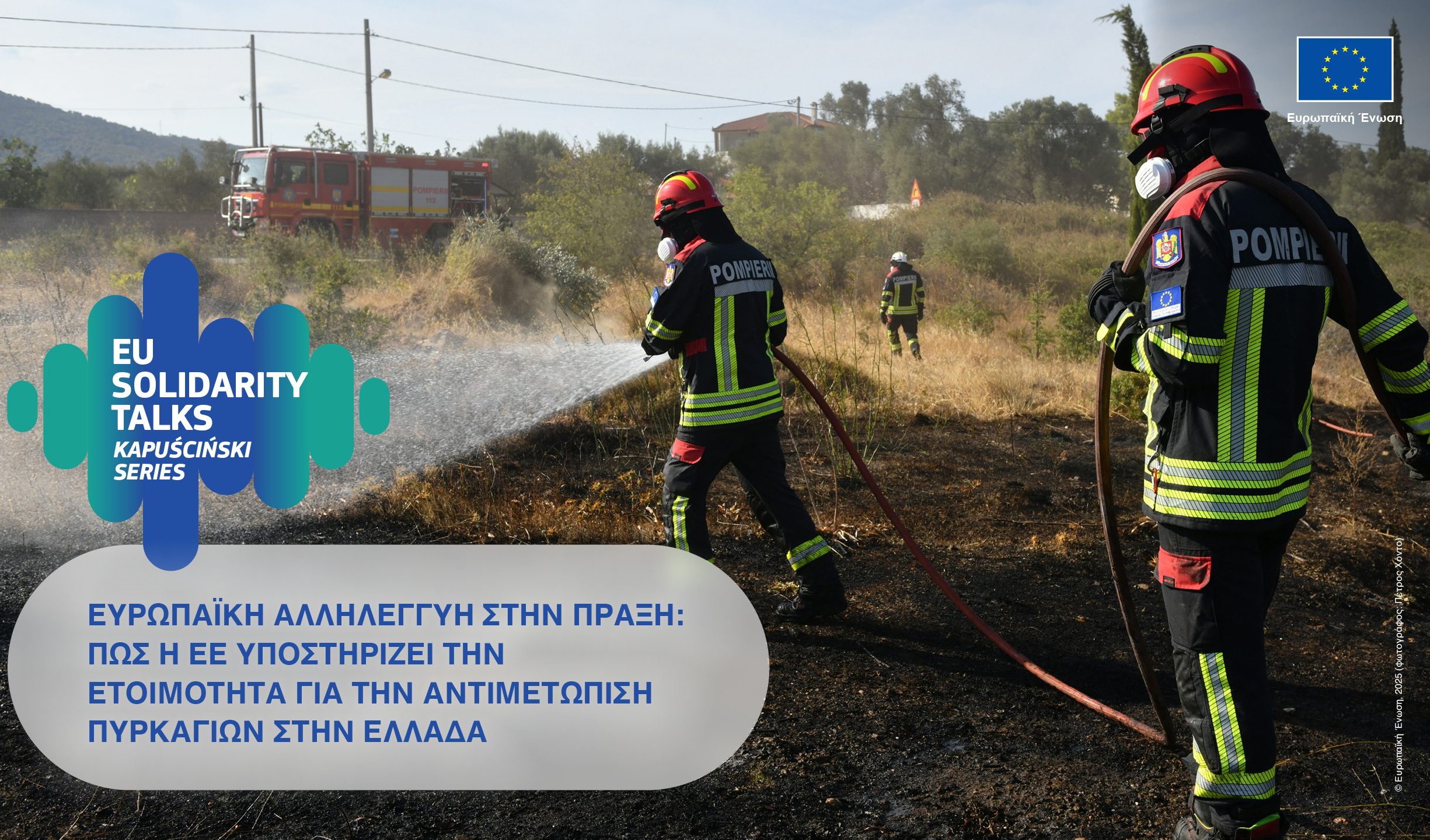
fyi.news, in partnership with European Commission’s Department for Civil Protection and Humanitarian Aid and Operations, held a panel talk on “European Solidarity in Action: How to Strengthen Greece’s Wildfire Preparedness?” as part of the EU Solidarity Talks: Kapuściński series. Put simply, it was a discussion about how European solidarity works in practice, especially when it comes to something Greece knows all too well: wildfires.
Wildfires are no longer just about “a difficult summer.” They are part of the climate crisis. They are faster, more intense, and more unpredictable. And they are often so large that no country can tackle them alone. This was the central message of the discussion: civil protection is no longer solely a national responsibility—it is a European one.
The panel talk gathered experts from the European Commission, fire services and academia. Spyros Afentoulidis, Head of the Analytical Team at the European Commission’s Emergency Response Coordination Centre, explained how the EU Civil Protection Mechanism (UCPM) works in practice. Established more than 20 years ago, it aims to strengthen civil protection cooperation between the EU countries and 10 participating states: Albania, Bosnia and Herzegovina, Iceland, Moldova, Montenegro, North Macedonia, Norway, Serbia, Türkiye, and Ukraine . Any country hit by a disaster, in Europe and beyond, can request emergency assistance through the mechanism. The Commission plays a key role in coordinating the disaster response and contributing to the transport and/or operational costs of deployments.
An extra layer of protection
Today, rescEU, an additional layer of protection, complements offers by EU Member States and participating states, when necessary. The UCPM is far more than a coordination platform. The mechanism also helps advance disaster prevention and preparedness activities among national authorities and fosters the exchange of best practices, including early-warning systems, and prepositioning of teams and assets that can be deployed whenever needed.
For this year’s wildfire season, that means 777 firefighters from 14 countries will be pre-positioned in high-risk areas across different parts of Europe
For this year’s wildfire season, that means 777 firefighters from 14 countries will be pre-positioned in high-risk areas across different parts of Europe so they can provide immediate assistance without losing valuable time. In addition, there are 23 European aerial assets (18 aircraft and 5 helicopters) and 31 pre-committed teams that can be mobilized if a country requires support. And in this context, time is the key word.
Zisoula Dasiou, an officer of the Hellenic Fire Service, explained that extreme wildfires no longer behave the way they used to. They create their own microclimate, alter wind speed, reduce humidity, and can move in directions that are difficult to predict.
In practical terms, this means firefighters no longer have hours to plan their response. Sometimes, they only have a few minutes.
Greece, particularly in the wake of the devastating wildfires of recent years, has fundamentally changed its approach, placing greater emphasis on rapid initial attack and immediate response to emerging fires.
Greece, especially after the devastating fires of recent years—from Mati and Evia to Rhodes and Alexandroupoli—has changed its approach. The emphasis is now on attacking fires immediately. As soon as there is a report of smoke, vehicles, personnel, and aerial resources are dispatched without delay.
The country has also strengthened its capabilities through additional aerial assets, specialized forest firefighting units, drones for rapid detection, and closer cooperation with scientists to better understand what happens inside a wildfire.
One of the most interesting examples discussed was the use of meteorological balloons within active fires. After all, understanding the weather around a wildfire is very different from understanding what is happening inside the fire itself.
The key takeaway is that suppression alone is not enough; effective wildfire management also requires prevention through sustainable forest management.
The key takeaway is that suppression alone is not enough; effective wildfire management also requires prevention through sustainable forest management. Konstantina Kotaridi, Director of the Master’s Programme in Bioeconomy, Circular Economy and Sustainable Development, introduced another crucial dimension to the discussion: prevention through the management of forests.
As she explained, forests accumulate residual biomass—branches, leaves, pinecones, and other natural materials—that can act as fuel. If left unmanaged, this material can intensify large-scale wildfires.
However, this biomass does not have to be treated as waste. It can be converted into biogas, energy, biomaterials, or soil enhancers. In other words, it can both protect forests and create economic value for local communities.
At this point, the discussion moved beyond firefighting and toward the broader concept of resilience. A society is not resilient simply because it possesses extensive resources. It is resilient when it works together—when public services, scientists, universities, local communities, and citizens all understand their role before a crisis occurs.
A major wildfire does not only damage the natural environment; it also affects a destination’s image, its infrastructure, the safety of residents and visitors, and the local economy.
The conversation also touched on tourism. Professor Petros Maravelakis, President of the Department of Tourism Studies at the University of Piraeus, explained that a major wildfire does not only destroy forests. It also damages a destination’s image, its infrastructure, the safety of residents and visitors, and the local economy.
The consequences can be immediate, such as cancellations and revenue losses, but they can also be long-lasting: reputational damage, higher insurance costs, falling property values, and financial pressure on local communities. Wildfire preparedness is therefore not only an environmental issue. It is also a matter of safety and economic stability.
Professor Fotini Asderaki, from the Department of International and European Studies at the University of Piraeus, placed the discussion within a broader European context. As she emphasized, European solidarity becomes truly visible when citizens see it in action during times of need.
When a region has been devastated, assistance arriving a year or even eighteen months later is not enough to make people feel that Europe was genuinely there for them.
For solidarity to work more effectively, it requires greater speed, increased funding, and less bureaucracy. When communities are struggling to recover, delayed support weakens citizens’ sense that Europe stood by their side.
The event’s final message was simple: the wildfires of the climate crisis era cannot be addressed with outdated approaches. They require prevention. They require technology. They require science. They require education. They require trust. And above all, they require cooperation.
Because European solidarity is not an abstract concept buried in a Brussels document.
It is the firefighters arriving from another country before it is too late. It is the sharing of aerial resources. It is the exchange of data. It is the knowledge of one country helping save lives in another. And ultimately, it is the recognition that when facing a fire that knows no borders, protection cannot have borders either.


 What is fyi.news?