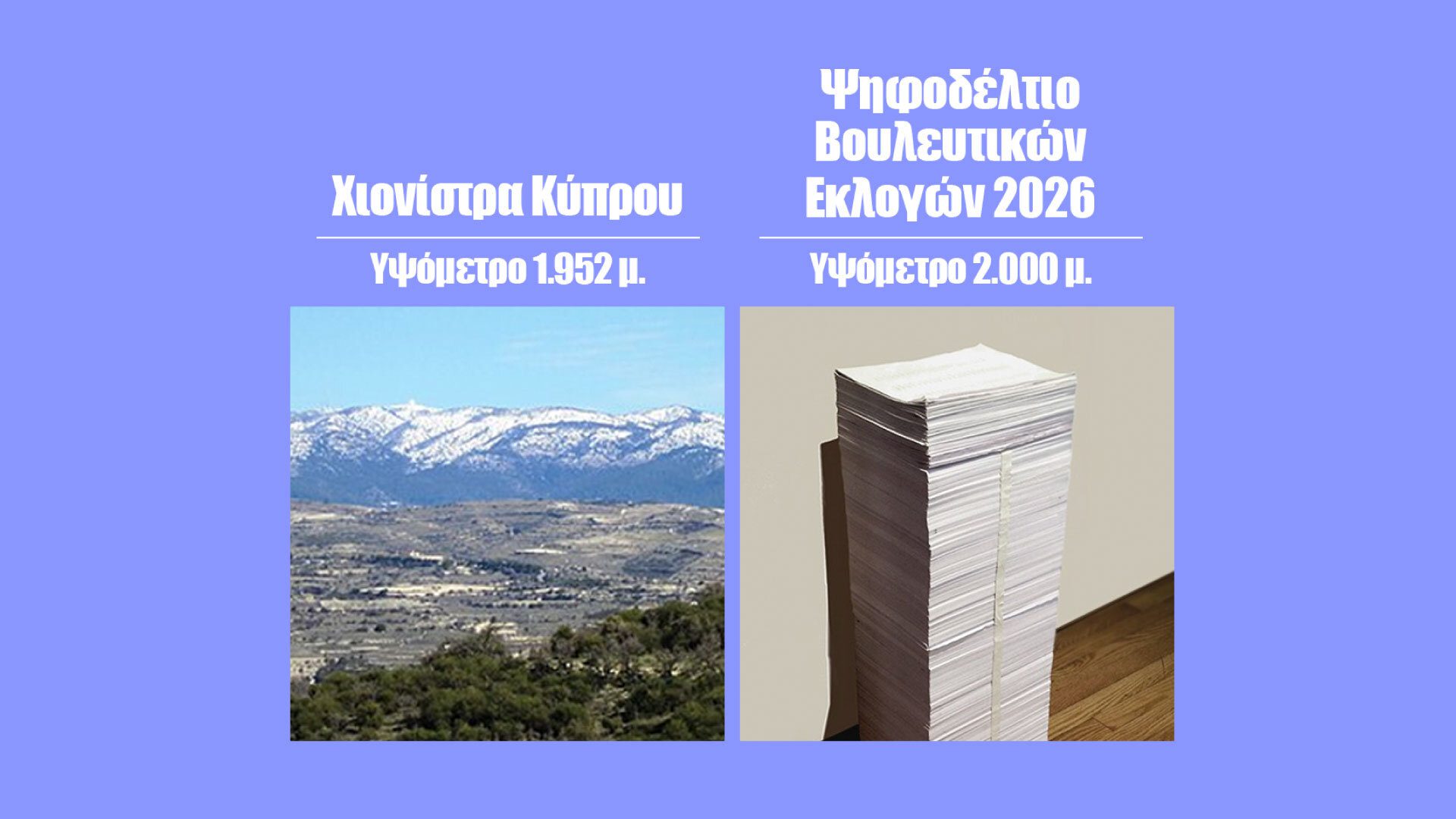
This year’s parliamentary elections in Cyprus are scheduled for Sunday, May 24, with a record number of candidates (753 candidates across 19 electoral lists).
They are held every five years and determine the composition of the House of Representatives.
They take place on the second Sunday of the month preceding the expiration of the term of the outgoing House.
What system of government does Cyprus have?
Cyprus has a Presidential Republic system, and parliamentary elections are held independently of presidential elections.
The Constitution of the Republic of Cyprus clearly separates the three branches of government:
Executive power is exercised by the President, the Vice President* and the Council of Ministers. Legislative power is exercised by the House of Representatives, while judicial power is independent and exercised by the courts of the Republic of Cyprus.
*The position is vacant; see Slide 7.
What is the role of the House of Representatives?
The House is primarily a legislative body, and its role is to enact, amend, or repeal laws.
At the same time, it exercises parliamentary oversight, meaning it scrutinizes the government, which is appointed by the President elected in presidential elections.
The House also approves the state budget, ratifies international treaties, and may revise the Constitution, with the exception of its fundamental provisions.
The duties of a Member of Parliament
- To participate in the legislative process by voting on laws
- To submit legislative proposals and amendments
- To participate in parliamentary committees (Health, Defence, Finance, etc.)
- To submit questions to the competent ministers
- To approve (or reject) the state budget and international agreements
Electoral districts and seats
The territory of Cyprus is divided into six electoral districts, with 56 Greek Cypriot seats and 24 Turkish Cypriot seats (which are vacant; see Slide 7).
Of the 56 seats, 20 are allocated to Nicosia, 12 to Limassol, 11 to Famagusta, 6 to Larnaca, 4 to Paphos, and 3 to Kyrenia.
What happens to the Turkish Cypriot seats?
The 1960 Constitution provided for a strictly bicommunal system, with a Greek Cypriot President and a Turkish Cypriot Vice President.
At the time, the Constitution provided for 35 Greek Cypriot seats and 15 Turkish Cypriot seats. This was changed in 1985, when the numbers were increased to 56 and 24 respectively.
Following the clashes between Greek Cypriots and Turkish Cypriots in 1963, Turkish Cypriots withdrew from their positions in the House and the government. To this day, the position of Vice President remains vacant, as do the Turkish Cypriot seats.
What is the electoral system?
The Constitution does not define a specific electoral system nor does it establish electoral districts. These matters are regulated by legislation passed by the House.
Until 1979, the electoral system was majoritarian. Later, an enhanced proportional representation system was introduced, and since November 2015 the electoral law has been amended so that simple proportional representation is now in force*.
*Parties receive seats in proportion to their share of the vote. Coalition governments are often formed, as obtaining an outright majority (50% + 1) is difficult.
What is the composition of the House today?
The current composition of the House is as follows:
- Democratic Rally (DISY): 17 seats (Centre-right)
- Progressive Party of Working People (AKEL): 14 seats (Communist/Left-wing)
- Democratic Party (DIKO): 11 seats (Centrist)
- Democratic Front (DIPA): 3 seats (Liberal)
- National Popular Front (ELAM): 3 seats (Far-right)
- EDEK – Socialist Party: 2 seats (Centre-left)
- Ecologists’ Movement – Citizens’ Cooperation: 2 seats
- Independents: 4 seats
What do the polls say?
Opinion polls show the two largest parties in the current House, the centre-right DISY and the communist/left-wing AKEL, competing closely for the top two positions.
The party appearing to gain the most momentum, however, is the far-right ELAM.
For example, a poll published by Politis shows DISY in first place with 19.5%, AKEL with 17.5%, and ELAM with 14% (followed by: Alma with 9.4%, Direct Democracy with 8.7%, DIKO with 7.8%, Volt with 7.2%, and EDEK and DIPA between 3.6% and 3.9%).
Sources:
Βουλή των Αντιπροσώπων [1], [2], [3], [4], [5], [6]
Φιλελεύθερος
 What is fyi.news?