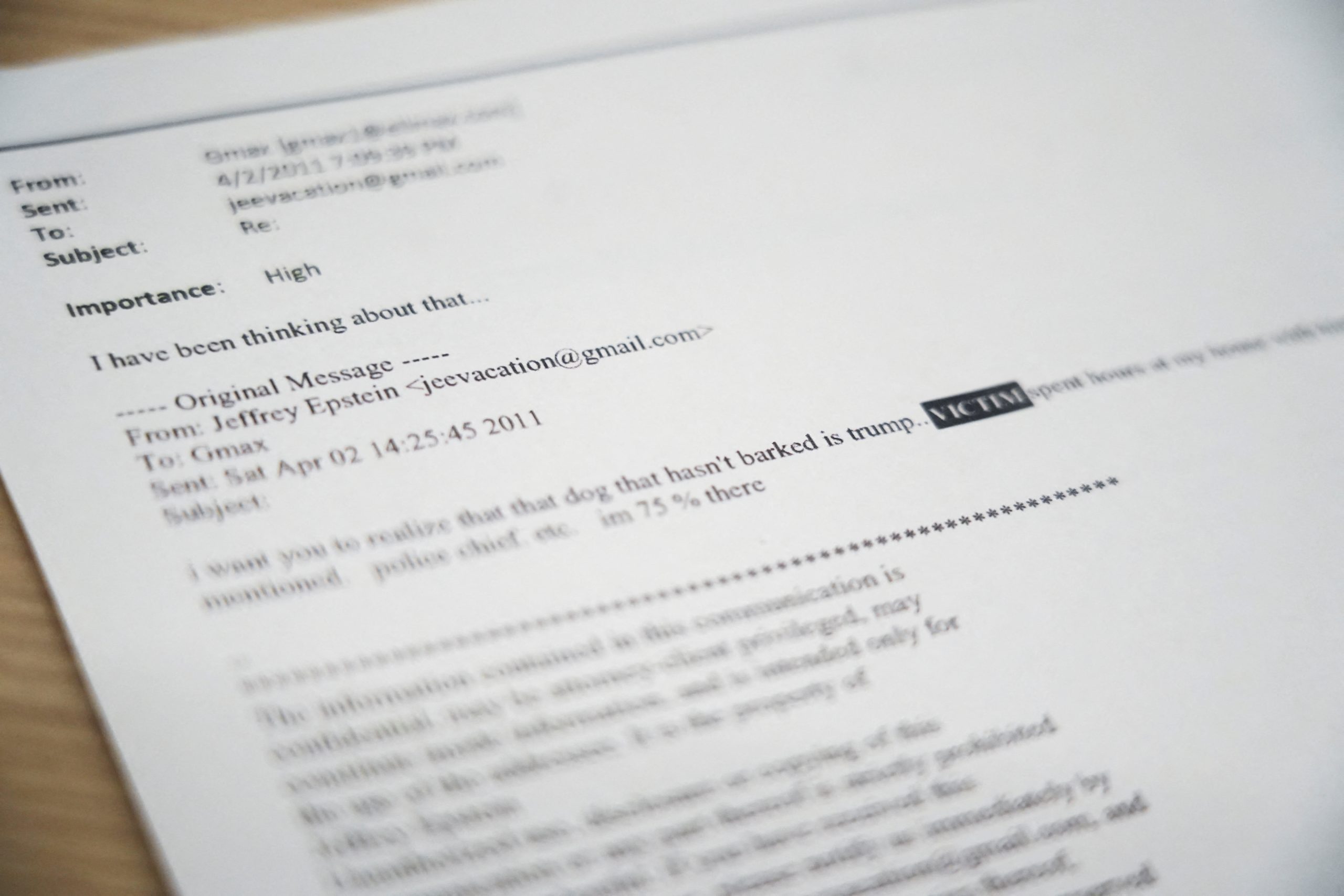
Democratic members of Congress yesterday released three isolated emails sent to or from Jeffrey Epstein that mention the name of Donald Trump.
The businessman convicted of sexually abusing minors, who died in prison in 2019, and the U.S. president had a friendly relationship in the 1990s. That relationship has now become a political problem in his second term, as he refuses to follow through on his campaign promise to release the full set of case files.
The first email (2011), written by his former partner and convicted accomplice Ghislaine Maxwell, states among other things that Trump “spent hours” with one of Epstein’s victims, whose name was not made public.
The second (2015), from writer Michael Wolff, says: “If [Trump] says he’s never been at the house or on the plane, then that gives you a valuable PR and political currency.” The third (2019), from Epstein to Wolff, reads: “Obviously [Trump] knew about the girls.”
The publication of all case files related to Jeffrey Epstein, who was convicted of sexually abusing minors, was a central campaign promise of Trump.
White House press secretary Karoline Leavitt called the “selective leaking” of emails a “false narrative intended to smear” Trump by Democrats. The White House also said that the victim’s name mentioned in the first email is Virginia Giuffre (the BBC confirms the name “Virginia”), who, before her suicide in April, had “repeatedly stated that President Trump was not involved in any wrongdoing.”
Also yesterday, a House committee with a Republican majority released an additional 23,000 pages of case records, which, regarding the relationship between the two men, show that Epstein kept an eye on Trump’s travels years after the two had ended their association.
Finally, the 218th signature was secured yesterday (from Democratic representative Adelita Grijalva), allowing the House to hold a vote on publishing the full set of case files. The vote will be scheduled for next week, and a major “defection” of Republican lawmakers from Trump’s stance is expected — potentially 100 or more, according to Politico.
BBC [1], [2], [3], Guardian, Politico


 What is fyi.news?